

Key Takeaways
- Covered fast food restaurant employees must be paid at least $20.00 an hour, a rate set starting April 1, 2024.
- The fast food minimum wage covers limited-service restaurants in national chains with at least 60 locations, including franchises.
- Prep work, closing tasks, and time spent waiting for a rush while under the employer’s control are hours worked and must be paid.
- If a required meal or rest break is not provided, the employer owes one additional hour of pay for that workday.
- Indoor work areas that reach 82 degrees Fahrenheit must have free drinking water and a cool-down area.
Fast food workers in California have specific protections, including a higher minimum wage at large chains, paid breaks, heat safety rules for hot kitchens, and freedom from retaliation. Abramson Labor Group represents cashiers, cooks, drive-thru workers, and shift leads, never employers. Our case reviews are free and confidential, and we work on contingency.
Why Fast Food Workers Choose Abramson Labor Group
- Employees only. We represent workers, never restaurant owners or franchisees.
- 4.5 stars across more than 1,900 Google reviews (as of September 2026).
- Documented results. See our case results. Past results do not guarantee a similar outcome.
- Founding partner Zev Abramson founded the firm in 2015 and earned his J.D. at Loyola Law School.
- Help in English and Spanish, with intake also available in Armenian.
What Is the Fast Food Minimum Wage in California?
According to the Labor Commissioner’s fast food minimum wage FAQ, “Starting April 1, 2024, all ‘fast food restaurant employees’ who are covered by the new law must be paid at least $20.00 per hour” (Labor Code 1475). The rate can be changed later, so check the FAQ for the current amount.
The law covers limited-service restaurants, where customers order and pay before eating, that belong to a national chain of at least 60 establishments and are primarily engaged in selling food and drinks for immediate consumption. It applies whether or not the employer is the company that owns the brand, so franchise locations are covered. Some locations are exempt, such as certain bakeries, grocery store restaurants, and restaurants in airports or hotels (DIR fast food FAQ). The 2026 statewide minimum wage for other workers is $16.90 an hour.
When Is Overtime Owed in Fast Food?
Nonexempt employees earn at least one and a half times their regular rate for work over eight hours in a workday or over 40 hours in a workweek, and for the first eight hours on a seventh straight day of work. Work over 12 hours in one day, or over eight hours on that seventh straight day, earns double time (Labor Code 510). Our wage and overtime page explains how these claims work.
Prep, cleaning, and closing tasks count. California’s wage order for restaurants defines hours worked as “the time during which an employee is subject to the control of an employer,” including “all the time the employee is suffered or permitted to work, whether or not required to do so” (IWC Wage Order 5, section 2(K)). Read more about off-the-clock work in California.
A shift lead or assistant manager title does not decide overtime. The actual job duties and pay must meet the legal test for an exemption (IWC Wage Order 5, section 1(B)). Learn more in our article on hourly vs salary employees in California.
- You are paid less than the fast food minimum wage at a covered chain
- You are told to wait until a rush starts before clocking in
- Prep or closing work happens after you clock out
- Breaks are skipped or cut short when it gets busy
- The kitchen is very hot and there is no cool place to rest
- Your hours were cut after you complained
What Meal and Rest Breaks Do Fast Food Workers Get?
An employer cannot employ someone for more than five hours a day without a meal period of at least 30 minutes, or more than 10 hours without a second one, with limited waivers for shorter days (Labor Code 512). Rest periods are a net 10 minutes for each four hours worked “or major fraction thereof,” and they are paid (DLSE rest period FAQ). When a required break is not provided, the employer owes “one additional hour of pay at the employee’s regular rate of compensation” for each workday (Labor Code 226.7). See our guide to meal and rest break requirements.

What Heat Rules Apply in Hot Kitchens?
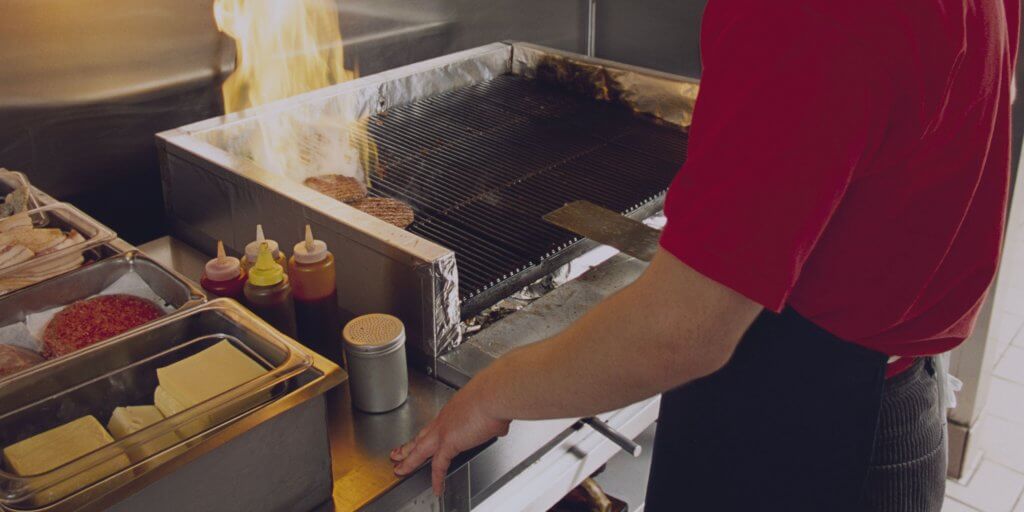
California’s indoor heat standard covers “all indoor work areas where the temperature equals or exceeds 82 degrees Fahrenheit when employees are present” (Cal. Code of Regulations, title 8, section 3396). Grills and fryers can push a kitchen past that line.
| Requirement | What the standard says |
|---|---|
| Water | “Employees shall have access to potable drinking water,” free of charge and close to where they work |
| Cool-down area | The employer “shall have and maintain one or more cool-down areas at all times while employees are present” |
| Cool-down temperature | Kept below 82 degrees Fahrenheit unless the employer shows that is infeasible |
If you were burned, slipped, or got sick from heat on the job, workers’ compensation applies “without regard to negligence” to an injury “arising out of and in the course of the employment” (Labor Code 3600). Our workers’ comp benefits overview explains what you may be owed.
Can My Employer Retaliate If I Complain?
No. “A person shall not discharge an employee or in any manner discriminate, retaliate, or take any adverse action” against an employee for complaining about unpaid wages or other rights the Labor Commissioner enforces (Labor Code 98.6). Fewer hours, write-ups, or a firing after a complaint can count. See our retaliation page. These rights apply regardless of immigration status, except reinstatement remedies barred by federal law (Labor Code 1171.5).
How Long Do I Have to Act?
Different claims have different deadlines. For many harassment, discrimination, and retaliation claims under FEHA, an employee generally has three years from the date they were last harmed to begin the filing process with the California Civil Rights Department. Wage claims and workers’ comp claims follow their own rules. An employment attorney can evaluate which deadlines apply to you.
Serving Fast Food Workers Across California
We represent fast food workers in Burbank, Glendale, Pasadena, and across Los Angeles County, and statewide through our California employment lawyers.
Frequently Asked Questions
How much does a lawyer for fast food workers cost?
We work on contingency, so you do not pay anything unless we win. The case evaluation is free. Our fee is a share of any recovery, and if there is no recovery, you owe no attorney fees.
Does the $20 minimum wage apply at every fast food restaurant?
No. It applies to covered limited-service restaurants in national chains with at least 60 establishments, including franchises, with some exemptions (DIR). Other restaurants must pay at least the state minimum wage or a higher local rate.
What if my manager asks me to work off the clock?
Time you are required or permitted to work is hours worked and must be paid, including prep and cleanup (IWC Wage Order 5, section 2(K)).
Can I be punished for reporting a safety problem?
Reporting a reasonably suspected violation of law to a supervisor or an agency is protected (Labor Code 1102.5). An employment attorney can evaluate whether what happened to you was retaliation.
Request a Free Case Review
If something is wrong with your pay, breaks, or safety at work, we can review what happened and explain your options. Request your free case evaluation, contact us, or call us at (213) 493-6300.
You do not pay ANYTHING unless we win!
Last updated: October 2026
This page is general information about California law, not legal advice. Every situation is different. For advice about your specific case, talk to a licensed California employment attorney.